
How to Check Pilates Reformer Quality Before Importing from China
Verifying the quality of a Pilates Reformer imported from China calls for a practical approach.
Some sourcing guides advise requesting business licenses, extensive technical documents, or 20-30 minute inspection videos at the first inquiry.
Before requirements, pricing, and purchase intent are clear, these demands add friction, even with reliable manufacturers. Buyers don't need to run a factory audit or act as professional inspectors.
Reformers at different price points differ in materials, build quality, workmanship, and user experience. Judge quality against your budget, target market, and intended use, and keep essential safety requirements non-negotiable.
1. Set Quality Standards by Budget and Market
Decide what quality you need before you evaluate suppliers. Your budget and your customers' tolerance for minor flaws determine the standard. An entry-level Reformer should not be judged like a premium commercial model.
Market segment | Quality priorities | What to expect |
Budget / entry-level | Safety, function, reliability | Minor cosmetic flaws, slight differences in padding firmness and small variations between machines can be acceptable at the right price. |
Standard commercial | Smoothness, stability, consistency | Quiet, smooth carriage movement under load, a secure footbar lock, and even padding with no hard spots or dents. |
Premium commercial | Materials, workmanship, consistency | Uniform padding, the same feel across machines, clean finishing underneath, neat upholstery edges and better materials. |
At any price, an unreliable footbar lock, a sticking carriage or an unstable frame is a safety defect and is not acceptable.
2. Check Quality Through Videos and Samples
Once the price fits your budget, ask the supplier for three short, unedited videos with original sound:
Carriage movement: the empty carriage moving back and forth, then a normal footwork exercise. Listen for noise, friction or sticking, and watch for frame movement.
Footbar adjustment: the footbar moving between positions and locking in place.
Construction details: close-ups of the rollers, rails, hardware, frame joints and the upholstery finish underneath the carriage.
If you are working with a new supplier and cannot visit China, order a sample first. Check its materials, configuration and workmanship, and keep it as the reference for bulk production.
3. Visit the Factory and Test the Machines
At the factory, use the machines instead of just looking at them. Do basic exercises, adjust the footbar and test the other adjustable parts. Check how smoothly and quietly the carriage moves, with and without springs, following the manufacturer's instructions.
Press the padding on the carriage, sitting box and shoulder rests, especially at edges, corners and seams, and feel for uneven firmness, hard spots or dents. If several machines of one model are available, test them in turn and compare carriage movement, noise, padding and adjustments.
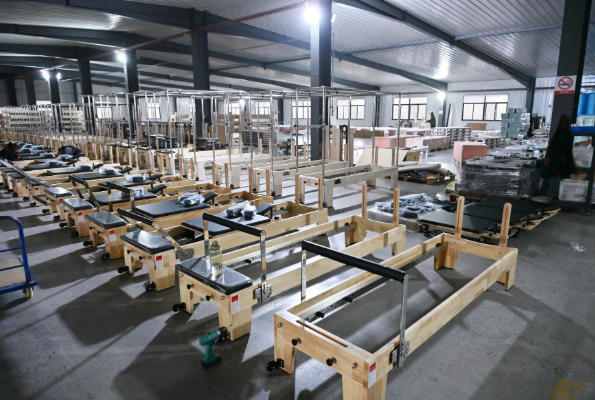
Then walk through the workshop to see the frames, components, assembly and packaging. Ask the supplier about the differences between standard and upgraded configurations, replacement parts and quality control.
4. Inspect the Bulk Order Before Shipment
Before paying the balance, have the production batch checked against the agreed specifications and the approved sample. Inspect several randomly selected machines for:
carriage movement and footbar locking
frame alignment and spring resistance
padding consistency and overall workmanship
Also confirm the materials, net weight, dimensions, accessories and export packaging.
If you cannot visit, ask for detailed photos and videos of the finished machines, or arrange a live video inspection. If you are in China, inspect the order in person.
Resolve any difference in quality, materials or configuration before the goods ship and you pay the balance.


