
Why Some Pilates Studios Put Towers on Every Reformer
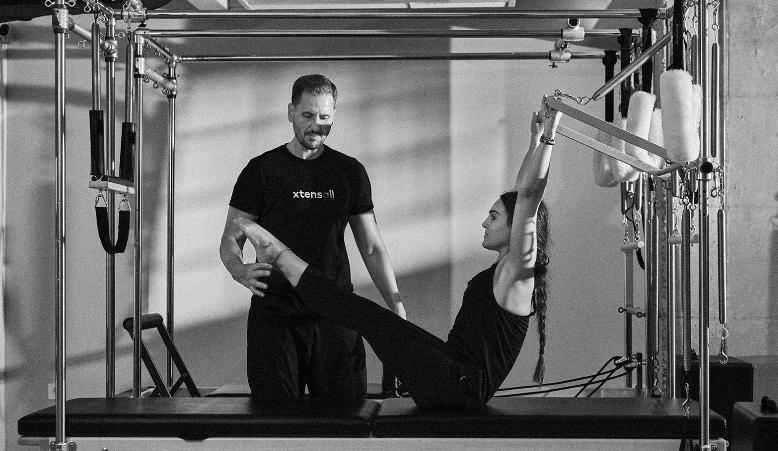
At Xtensall Castelló in Madrid, the main Pilates room has eight Reformers with Towers, along with eight High Chairs. Upstairs, another room has four more Tower-equipped Reformers. That makes twelve across a studio offering both group and private sessions.
It's an interesting choice. Many studios buy conventional Reformers for group classes and keep one or two Towers for private teaching. Xtensall has taken a different approach: every Reformer station has its own Tower.
And it's not the only studio doing this. Several Pilates studios in Spain have equipped entire group-class rooms with Tower Reformers. Their layouts raise a practical question for anyone planning a new studio: when is it worth paying for a Tower on every machine?
1. What an All-Tower Pilates Studio Looks Like
Xtensall Castelló is a useful starting point because its two rooms show how the same equipment can work at different class sizes. The larger room has eight Tower Reformers, while the smaller room upstairs has four. Neither is presented as a separate Tower-only treatment area.
In Valencia, Stone Pilates Ayuntamiento has a similar arrangement. Its larger group room contains five Reformers with Towers, and a second room contains four more. The studio offers both group and individual sessions.
Club 8, also in Valencia, has a smaller setup: five Reformer beds, all equipped with Towers. Its website describes the additional Tower structure as a way to combine carriage movement with stable, spring-based work.
These three studios operate on different scales, but their equipment arrangements have something in common. A client joining a Reformer class doesn't need to book a particular machine to have access to Tower equipment. The Tower is already part of every station.
That changes what an instructor can include in a group session. It also changes how the studio can organize different classes in the same room.
2. What Changes When Everyone Has Access to a Tower?
Consider a group of six students working on conventional Reformers. The instructor can teach footwork, leg straps, rowing and many other exercises using the moving carriage. If the class also includes a series using Tower arm springs, however, the room needs the appropriate equipment.
With only one or two Towers, the instructor has to arrange rotations, adapt the exercise for the other students or teach that part of the program separately.
When every Reformer has a Tower, all six students can perform the spring-based series at their own stations. The instructor can demonstrate the same movement, give corrections and adjust resistance for individual students without dividing the group between different apparatus.
The advantage is particularly clear when Tower work is a regular part of the teaching program. A class might begin with carriage-based footwork and later include arm springs or a Roll-down Bar exercise. Students don't need to move across the room to another piece of equipment.
That doesn't mean the transition is automatic. Springs and bars may need repositioning, and some exercises require a different carriage or platform setup. The instructor still has to prepare the equipment and allow enough time between exercises.
It also doesn't mean every class must use the Tower. A studio can teach an ordinary Reformer session on Tower-equipped machines without using the vertical frame at all.
The difference is availability. If the instructor wants the entire group to use Tower springs, the equipment is there for everyone, rather than for whichever students happen to be beside the one Tower station.
3. Tower Equipment Can Become Part of the Class Menu
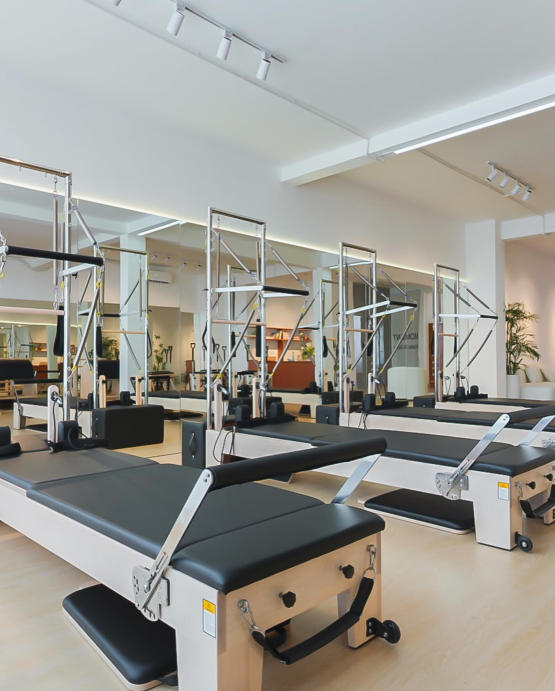
Club 8 provides an interesting example of how Tower equipment can extend beyond the occasional exercise in a Reformer class.
The Valencia studio has five Tower-equipped Reformers, and its membership offers include a Pilates class called Tower & Mat. Both its 8+1 and 12+1 class packages include a Tower & Mat bonus session.
That's a more specific use of the equipment than simply advertising that every bed has extra springs.
Mat Pilates relies largely on bodyweight and floor-based movements. Tower training introduces spring resistance and assistance, with exercises performed in relation to a fixed surface or apparatus. Depending on the equipment, a Reformer with Tower may also accept a Mat Converter that creates a stable platform over the carriage.
Club 8 doesn't publish a complete teaching sequence for its Tower & Mat classes, so we can't assume exactly how its instructors arrange the equipment. What its class packages do confirm is that Tower & Mat has a distinct place in the studio's offering.
For an owner planning a new studio, that distinction matters. Buying five Towers is easier to justify when the equipment is intended for named classes that appear regularly in the schedule. It is harder to justify if every session will follow the same Reformer-only program.
The question isn't how many additional exercises a Tower makes possible. It's how many of those exercises the studio genuinely intends to teach.
4. What It Takes to Equip Every Reformer with a Tower
An all-Tower room requires a different purchasing calculation from a room that has one or two specialist machines.
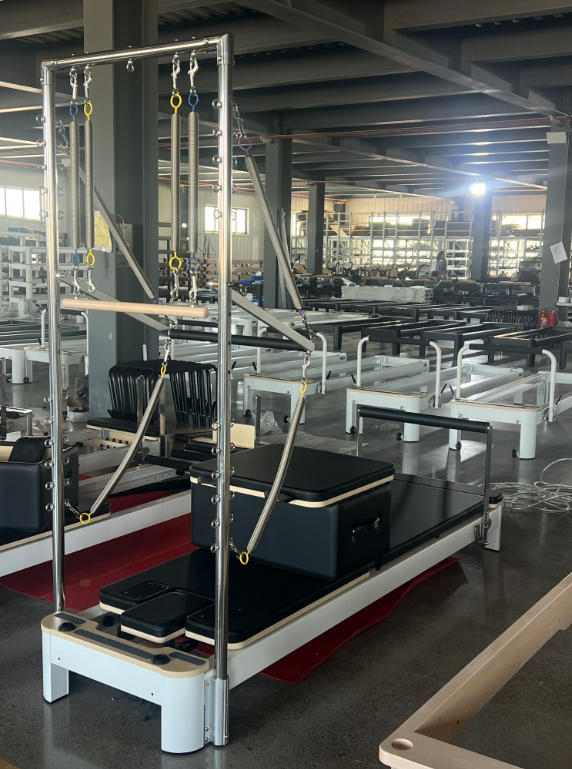
If a studio plans to install eight Reformers, adding Towers to all eight means paying for eight Tower assemblies rather than two. The difference involves more than the upright frame. Depending on the model, the equipment may require Tower springs, bars, mounting hardware, safety components and Mat Converters.
The accessory list deserves particular attention. If eight students are supposed to use a Roll-down Bar at the same time, the studio needs eight compatible setups. A quotation that includes some accessories as optional extras can look attractive until the owner calculates the complete room.
Ceiling height also needs checking before the order is placed. A Tower may fit physically under a ceiling while still lacking the clearance needed for certain bar movements. The usable height matters more than the frame height alone, especially in rooms with beams, lighting or air-conditioning units overhead.
There are smaller daily considerations too. Springs need to be arranged correctly for each exercise, and the instructor may need to reset bars or equipment between different class formats. In a room of eight machines, even a short preparation task becomes noticeable when it has to be repeated at every station.
That is why it's worth comparing complete Reformer with Tower models, not just photographs of different frames. The exact accessories, dimensions and intended exercises should be checked before buying a full room of machines.
Teacher experience is another part of the decision. A studio gains little from having eight Tower stations if its instructors are only comfortable teaching conventional Reformer exercises. Before ordering, owners should know which Tower movements their teachers can deliver confidently and which require additional training.
None of these considerations makes an all-Tower room impractical. They simply mean the purchase should be planned around actual classes, with a complete equipment list and a clear idea of how the room will be used.
5. When Does Every Reformer Really Need a Tower?
Not every Pilates studio chooses to combine both functions in one machine.
Stone Pilates offers a useful contrast between two of its Valencia locations. At Ayuntamiento, both teaching rooms are equipped with Reformers with Towers. At Stone Campanar, the arrangement is different: one group room has eight Reformers, while another has eight Springboards for Matwork alongside eight Pilates Chairs. Campanar also has a separate room with a Cadillac Reformer.
The published layouts don't explain every reason behind these choices, but they show two workable ways to arrange spring-based Pilates equipment.
At Ayuntamiento, Tower functions are available at the Reformer stations. At Campanar, the studio has separate spaces for Reformer work and Springboard-based sessions.
For a studio with several rooms and a timetable that keeps these classes separate, a dedicated Springboard room may be practical. For a smaller studio where the same room must accommodate different types of Pilates teaching throughout the day, Tower Reformers may offer a useful alternative.
The deciding factor should be the weekly schedule.
Suppose a six-machine studio plans to teach Tower exercises to the whole group several times a week. Buying only two Tower-equipped Reformers would mean adapting those classes around the limited number of stations. Equipping all six positions would let the instructor teach the same Tower-based sequence to everyone, provided the room and equipment support it.
Now consider a studio where Tower work appears only in an occasional private appointment. Paying for six Towers may offer little practical benefit when one or two suitable stations could meet that demand.
There is also room for mixed equipment layouts. Studios that teach several apparatus-based formats may prefer planning a mix of Reformers, Half Towers and Full Towers instead of equipping every station identically.
The examples from Madrid and Valencia don't establish a standard equipment ratio for Spanish Pilates studios. What they show is that Tower Reformers aren't necessarily limited to private sessions or specialist corners. Some studios use them as the normal equipment for an entire group room.
For owners considering the same approach, the most useful starting point is a week's worth of planned classes. Look at where Tower exercises appear, how many students need access at once and whether those exercises could be taught more practically in a separate area.
If Tower work is part of everyday group teaching, putting a Tower on every Reformer can make sense. If it isn't, the extra frames may spend most of their time unused.
A fully equipped room is valuable when the teaching program gives every Tower a reason to be there.


Trending Now
-

How Much Does It Cost to Open a Pilates Studio in 2026?
2026-08-20 10:42:13 -

Reformer, Cadillac, Chair: How to Differentiate and Invest in the Right Pilates Equipment for Your Studio
2026-07-23 13:32:02 -

How to Choose a Commercial Pilates Reformer for Studio Use?
2026-06-08 14:07:56 -

How to Turn a Small Pilates Studio Into a Multi-Revenue Space
2026-05-29 15:19:19