
Why Do Indian Pilates Studio Chains Prefer Purchasing Aluminum Reformers?
In many Pilates studios, wooden Reformers still represent the classic premium look. Major brands(for example,Balanced Body) continue to position maple, cherry, mahogany, and walnut as part of a high-end studio identity, which helps explain why wood remains popular in the US and Europe.
India, however, is moving through a different stage of market development. The country’s fitness market is projected to grow from about INR 16,200 crore in 2024 to INR 37,700 crore by 2030, while boutique fitness is one of the fastest-growing formats. At the same time, the market remains fragmented and price-sensitive, which means many operators are focused less on heritage aesthetics and more on how to open, replicate, and manage studios efficiently.
Summary tables-India's emerging fitness economy-India fitness market report 2025
Country profile
(Source: Deloitte interview, research and analysis)
| Metric | 2024 (Current) | 2030 (Projected) |
|---|---|---|
| Total market size (INR crore) | 16,200 | 37,700 |
| Number of fitness facilities | 46,500 | 65,500 |
| Number of members (million) | 12.3 | 23.2 |
| Penetration rate (%) | 0.8 | 1.7 |
Geographical segment statistics
(Source: Deloitte interview, research and analysis)
| Segment | 2024 revenue (INR crore) | 2030 revenue (INR crore) | CAGR 2024–2030 (%) |
|---|---|---|---|
| Top 10 | 9,100 | 23,500 | 17.2 |
| Rest of India | 7,100 | 14,200 | 12.2 |
Facility market segment statistics
(Source: Deloitte interview, research and analysis)
| Segment | 2024 revenue (INR crore) | 2030 revenue (INR crore) | CAGR 2024–2030 (%) |
|---|---|---|---|
| Value | 9,000 | 20,000 | 14.2 |
| Premium | 6,100 | 14,600 | 15.7 |
| Boutique | 1,100 | 3,100 | 18.8 |
That is why aluminum Reformers often make more sense for Indian chain studios. The advantage is not based on one single factor. It comes from how aluminum fits the commercial logic of a growing chain: lower equipment cost, lighter delivery and installation, simpler multi-location standardization, and easier sourcing through Chinese supply networks that already dominate India’s Pilates Reformer imports.

1. Indian chain Pilates studios buy for growth, not just for aesthetics
The first point to understand is that chain studios do not buy equipment the same way single-location boutiques do.
A standalone boutique studio can make a design-led decision. It may choose wood because the machine contributes to a warm, classical, premium atmosphere. That is still a valid strategy, especially in markets where Pilates has already matured into a lifestyle category. Balanced Body’s wood pilates reformers offerings show exactly how strong that visual and branding logic remains in Western markets.
Indian chain studios usually operate under a different business logic. They are often planning not just one room, but a repeatable studio model. Once the goal becomes a second or third location, the Reformer is no longer just part of the interior. It becomes part of an expansion system.
That shift matters because India’s fitness market is still scaling. The Deloitte-HFA market report describes the sector as fragmented, with relatively few national-scale operators, while boutique fitness is expected to grow particularly quickly. In that environment, equipment decisions are shaped by rollout needs, not just by studio aesthetics.(India's emerging fitness economy-India fitness market report 2025)
So the central question changes. Instead of asking which machine looks more premium, Indian chain buyers are more likely to ask which machine is easier to deploy, easier to repeat, and easier to support as the business grows.

2. Aluminum Reformers are usually more affordable than Wooden Reformers
Once growth becomes the priority, price moves to the center of the buying decision.
Public pricing in India shows a clear pattern. Afton’s Nexa Aluminum Reformer is listed at INR 141,500, while its Veritas Spliced Maple Reformer is listed at INR 198,000. In the tower category, the Nexa White Aluminum Reformer with Tower is listed at INR 200,000, while the Veritas Spliced Maple Reformer with Tower is listed at INR 275,000.(AFTONFITNESS EQUIPMENT)
For one studio, that difference with Wooden Reformers and Aluminum Reformers may look manageable. For a chain, it scales quickly. A studio that needs six to ten Reformers is not evaluating one machine. It is evaluating the total equipment cost per branch.
Once that same decision has to be repeated across multiple locations, frame material starts to influence the overall capex model in a major way.
This is why aluminum is often attractive to Indian buyers before they even get into technical details.
It lowers the financial barrier to building a professional studio while giving operators more room to allocate budget to interiors, rent, marketing, staffing, or additional equipment. In a market that is growing fast but still price-sensitive, that flexibility matters.

3. Lower pricing supports the economics of chain expansion
The importance of lower pricing becomes clearer when it is connected to the economics of expansion.
India’s fitness market may be growing quickly, but affordability remains a structural reality. The Deloitte-HFA report highlights price sensitivity as one of the defining characteristics of the market, even as boutique and premium formats gain traction. That means studio owners cannot think about equipment only as a product purchase. They have to think about it as part of a broader investment model.
For chain Pilates studios, a lower-cost aluminum Reformer helps reduce rollout risk in several ways. It lowers the upfront cost of a new branch. It makes it easier to approve expansion decisions. It improves flexibility when opening in multiple cities. And it allows operators to preserve capital for other parts of the business that directly affect member acquisition and retention.
This is why aluminum is often chosen not as a budget compromise, but as a disciplined business decision. The lower purchase price supports a more scalable growth path, especially for brands that want to expand without making each new studio disproportionately expensive.
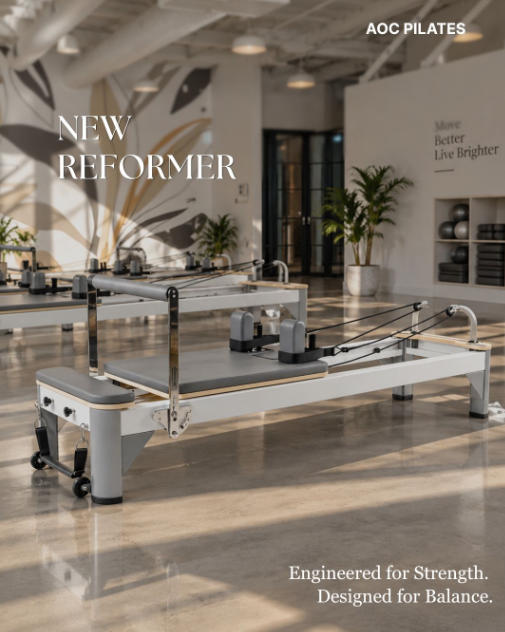
4. Aluminum Reformers are lighter, which makes delivery and installation easier
Price explains part of the preference, but not all of it. Weight is the next major reason.
On Afton’s India product pages, the Nexa Aluminum Reformer is listed at 72 kg net weight and 108 kg gross weight, while the Veritas Spliced Maple Reformer is listed at 104 kg net and 151 kg gross. That means the maple model is about 44 percent heavier in net weight and roughly 40 percent heavier in gross shipping weight.
That difference matters because Indian chain studios are often opening in dense urban environments where delivery and installation are not trivial. Mixed-use buildings, upper-floor locations, compact access points, elevators, manpower, and installation windows all affect how easily a studio can go live. A lighter machine reduces friction at every stage of that process.
The same logic becomes even more important at the scale of a chain rollout. A small weight difference on one machine becomes a large handling difference across six, eight, or twelve units. In that context, lighter aluminum equipment is not just easier to move. It is easier to replicate.
This is one reason aluminum feels more chain-friendly in India. It supports the operational reality of opening studios efficiently, not just the visual goal of outfitting them beautifully.

5. Indian buyers often use Chinese suppliers to lower total sourcing cost
Once pricing and logistics are considered together, sourcing naturally becomes part of the picture.
Volza’s India import data for Pilates Reformers indicates that, over the period from October 2023 to September 2024, China accounted for 94 percent of India’s Pilates Reformer import shipments. That does not prove that every Indian buyer chooses China solely for price, but it does strongly suggest that China is the dominant supply base for this category.(India's emerging fitness economy-India fitness market report 2025)
This aligns closely with how many Indian commercial buyers think. Chinese suppliers are attractive because they combine factory pricing, bulk order capability, OEM and private-label flexibility, and a mature export-oriented manufacturing base. For chain studios, this matters because procurement is rarely just about one shipment. It is about whether the same supplier can support repeated orders as more branches open.
That makes aluminum even more relevant. If aluminum models are already more affordable than comparable wooden models, and if Chinese suppliers are already the main source of Pilates Reformers entering India, then the preference for aluminum becomes easier to understand. It fits a sourcing logic built around cost control, volume purchasing, and repeatability.

6. Aluminum Reformers are easier to standardize across chain Pilates studios
Once a chain starts expanding, standardization becomes one of the biggest operational priorities.
A single standardized Reformer model makes studio planning easier. It simplifies layout decisions, maintenance routines, staff training, procurement, and future replacement planning. It also creates a more consistent member experience across branches.
This matters especially in India because many brands are still moving from one successful site to a repeatable model. In a fragmented market, the businesses that scale efficiently are often the ones that remove unnecessary variation from each new opening.
Aluminum helps with that because it is easier to fit into a standard rollout formula. It is more affordable, easier to handle, and simpler to source in batches. That combination makes it easier for a chain to say: this is our default Reformer specification across all locations.
So the logic becomes more coherent when seen as a sequence. Aluminum is often cheaper. Because it is cheaper, it supports better expansion economics. Because it is lighter, it is easier to install. Because it is easier to source and deploy, it becomes easier to standardize. And because it is easier to standardize, it suits chain growth better.

7. Wooden Reformers still suit a different studio model
That does not mean wooden Reformers are the wrong choice in general.
Wood still carries strong brand value in premium Pilates. Western manufacturers continue to highlight wood as part of a refined, classical, design-led studio environment. India’s own retail market also clearly supports wood, with maple and walnut options presented alongside aluminum models.
The difference is not that one material is universally good and the other is universally bad. The difference is that they often fit different business models.
A luxury flagship studio may still prefer wood because it wants visual warmth and a more traditional premium identity. A growth-stage chain in India is more likely to prioritize lower cost, easier deployment, easier sourcing, and standardization across locations. In that situation, aluminum is often the more practical fit.

8. Why aluminum fits the future of Indian Pilates expansion
As Pilates grows in India, the winning operators will not necessarily be the ones with the most luxurious single room. They will be the ones who can build a studio model that is commercially repeatable.
That is why aluminum Reformers are often better suited to Indian chain Pilates studios.
They match the market’s current priorities: disciplined capital allocation, efficient rollout, easier handling, and supply chain repeatability. The preference is not random. It is a direct response to how the Indian Pilates business is evolving.

9. Conclusion
So why are aluminum Reformers more suitable for Indian chain Pilates studios?
Because they solve more of the problems that chain operators actually face.
They are often cheaper than comparable wooden models, lighter to handle, easier to deploy, easier to standardize, and more compatible with the sourcing logic many Indian buyers already use, including Chinese suppliers for better cost efficiency.
Public product pricing supports the cost gap, trade data suggests China dominates India’s Pilates Reformer imports, and India’s own fitness market structure shows why expansion-focused buyers prioritize efficiency over material tradition.
Wood may still carry prestige. But for many Indian chain studios, aluminum carries something even more important: a better fit with how the business is actually growing.


Trending Now
-

Pilates Reformer vs. Reformer with Tower: Which One Do You Really Need?
2026-09-21 09:30:12 -

Types of Pilates Reformers: How Material, Frame Structure, and Environment Define Function
2026-09-10 10:29:31 -

Wood vs Aluminum: Which Pilates Reformer Is Right for Your Studio
2026-09-10 10:20:07 -

Why Maple & Oak Are the Go-To Woods for Wooden Pilates Reformers
2026-09-10 09:53:30 -

From Factory to Global Market: How to Transport a Pilates reformer Safely?
2026-05-27 11:03:16 -

Pilates Reformer OEM Customization Options for Manufacturers
2026-04-22 09:31:52