
Chain Pilates Studio Planning: Reformer, Half Tower, and Full Tower
For a chain Pilates studio, the question is rarely which format wins on its own. The more useful question is how Reformer, Half Tower, and Full Tower can work together inside one location to support daily group classes, progression-based programming, premium services, and a model that can be replicated across multiple sites.
In commercial planning terms, these three formats function as complementary roles inside one pilates studio: Reformer supports daily operating volume, Half Tower expands programming depth, and Full Tower supports premium and specialized services.

1. Why the Reformer Is the Core Operating Equipment of a Commercial Pilates Studio
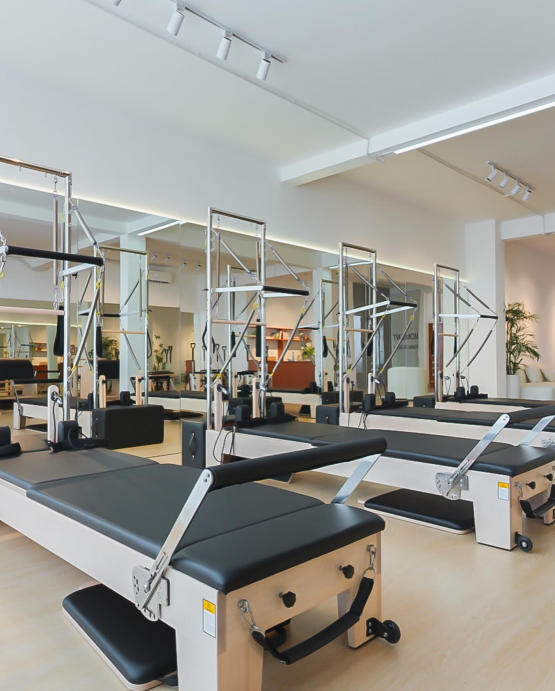
The Reformer is the operational backbone of most commercial Pilates studios. It is the most efficient way to build high-frequency class flow, standardized scheduling, and broad member participation. Merrithew's V2 Max line is positioned as a first choice for clubs, gyms, and studios with dedicated mind-body training space, covering both one-on-one and group settings.
Club Pilates is a clear real-world example. Its group-class model is built around Reformer training complemented by Springboard, Chair, TRX, and other apparatus — not replacing the Reformer, but layering around it. That is how a chain uses the Reformer as the scheduling and operating center while still adding variety.
In most commercial studios, Reformers carry the largest share of daily scheduling because they deliver class capacity, timetable stability, operational rhythm, and easier standardization across locations. They are not simply the "basic" machines. They are what keeps the business running at volume.

2. How Half Tower Improves Group Class Depth and Member Progression in Pilates Studios
Once the operational core is in place, the next question is how the studio moves beyond standard volume programming. This is where Half Tower becomes strategically useful.
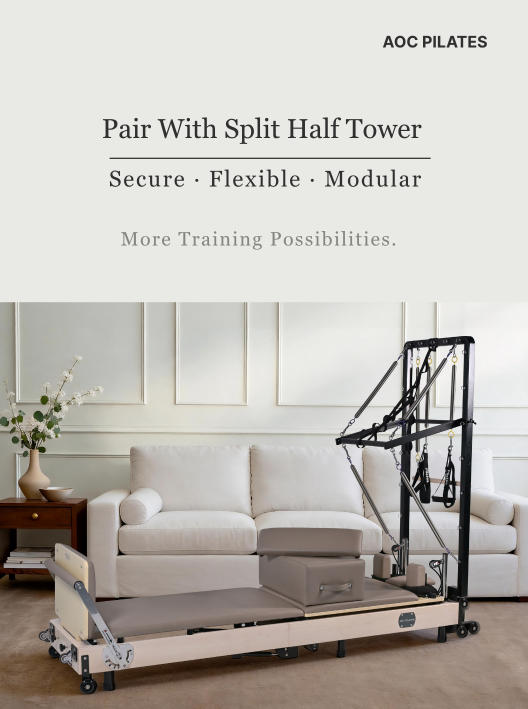
Half Tower works best as an upgrade layer. Its job is to expand exercise variety, create richer class design, and give members a visible next step after standard Reformer classes. Balanced Body's Reformer-with-Tower collection states that adding a Tower increases exercise options, helps target specific muscle groups, and allows clients to continue progressing.
From a studio-planning perspective, Half Tower makes the course menu feel deeper, gives instructors more programming range, and creates a clearer progression path for returning members. It is the most useful middle layer in a chain studio — adding meaningful training depth without taking too much floor share away from the Reformer base, while choices around Tower construction and frame material can be matched to how often the equipment needs to be moved or reconfigured.
3. How Full Tower Supports Private Sessions and Premium Pilates Studio Positioning
If Reformer carries daily volume and Half Tower supports progression, Full Tower becomes the studio's premium layer.
CARVE Pilates Studio in Singapore offers a practical example. It runs small-group Reformer/Tower classes alongside private 1-on-1 and duet sessions, and its service pages mention rehabilitative Pilates and multi-equipment use.
That shows how one studio can use Tower-based equipment not just for extra exercises, but for higher-value and more personalized services inside the same location.
Full Tower(Pilates Reformer vs. Reformer with Tower) is especially suitable for private sessions, advanced programming, specialized training, rehab-oriented sessions, and premium studio positioning.
In most commercial studios, Full Tower is not the highest-volume category. Its value is different: it supports higher-value services and helps the studio present a stronger professional image.
4. Reformer vs Half Tower vs Full Tower: Equipment Comparison Table for Pilates Studio Planning
Equipment | Main Role | Best Use Cases | Best-Fit Clients | Commercial Value |
Reformer | Operational core | Intro classes, group classes, high-frequency scheduling | Beginners, regular members | Builds daily capacity and standardization |
Half Tower | Upgrade layer | Progression classes, richer programming, intermediate formats | Returning members, progressing clients | Adds depth without over-premiumizing the room |
Full Tower | Premium layer | Private sessions, advanced work, rehab-oriented sessions | Premium clients, advanced users | Supports differentiation and higher-value services |
The point is to map equipment to business function: Reformer builds capacity, Half Tower builds progression, Full Tower builds premium value.
5. Recommended Reformer and Tower Equipment Mix Ratios for a Commercial Pilates Studio
There is no universal formula. The right mix depends on class structure, member profile, pricing strategy, and floor space. The ratios below are practical planning recommendations, not fixed rules.
Standard commercial studio
Reformer 65–75% / Half Tower 15–25% / Full Tower 5–10%
The most practical starting point. Keeps the room efficient for daily group-class flow while leaving space for progression programming and a limited premium layer.
Upgrade-oriented direct-operated studio
Reformer 55–65% / Half Tower 20–30% / Full Tower 10–15%
Works better for urban studios that want stronger member progression and a more layered class menu. Reformer still anchors operations, but the studio gives more room to upgraded programming.
Flagship or premium-service studio
Reformer 55–65% / Half Tower 15–20% / Full Tower 5–10% / Cadillac Reformer 10–15%
Even in a premium studio, Reformer usually remains the scheduling core. Full Tower expands private training and premium positioning, but rarely replaces the Reformer's operational role.
Franchise-friendly rollout format
Reformer 70–80% / Half Tower 15–20% / Full Tower 0–10%
The safest starting point for franchise formats. It protects capacity, simplifies training, and keeps the model commercially clear. Merrithew's MPX line is explicitly positioned as an entry-level commercial Reformer for multi-purpose studios, hotels, and franchise fitness centers, which fits this Reformer-led planning logic well.

6. How a Mixed Equipment Setup Covers More Member Segments and Pilates Revenue Layers
The advantage of combining all three formats is not just exercise variety. It is that one studio can support more customer segments and more pricing layers at the same time.
A Reformer-heavy base gives the studio its mainstream class engine.
Half Tower creates a progression layer for members who want more depth.
Full Tower creates a premium layer for private sessions and specialized work.
One location can serve first-time clients, regular class members, progressing members, advanced clients, and private-training clients — all within the same space.
That creates a stronger revenue structure: Reformer builds volume revenue, Half Tower supports upgrade revenue, and Full Tower supports premium revenue.
Club Pilates demonstrates the first part of that model at chain scale. CARVE demonstrates the second: one studio using Reformer/Tower formats for both small-group delivery and higher-value personalized services.

7. How Chain Pilates Studios Use a Standardized Equipment Model to Scale Across Locations
A chain does not scale by copying machines one by one. It scales by copying a working studio format.
If one location already supports mainstream classes, progression-based programming, and premium services, it becomes a much stronger template for future branches.
That is why the ratios above are intentionally conservative.
If Full Tower share is too high, replication becomes heavier and more premium-dependent. If the room is all standard Reformers, the model may be efficient but commercially too flat.
A balanced mix preserves capacity, progression, and premium value in one repeatable format.
8. The Core Logic of Pilates Studio Equipment Planning: Assign Roles, Not Just Products
For chain Pilates studios, the strongest decision is rarely to choose only one format. The better approach is to build one studio around three complementary roles: Reformer for operational volume, Half Tower for progression and program depth, and Full Tower for premium services and specialized work.
The goal is not to treat these three formats as equal substitutes. It is to decide how each one strengthens class capacity, member progression, pricing structure, studio positioning, and future replication. A successful chain studio is not built by asking which machine wins the comparison. It is built by assigning each machine a clear role inside a scalable business model.

FAQ
What is the best Reformer / Half Tower / Full Tower ratio for a chain Pilates studio?
A practical starting point for a standard commercial studio is 65–75% Reformer, 15–25% Half Tower, and 5–10% Full Tower. More premium studios can shift more room toward Half Tower and Full Tower, but Reformers usually remain the largest group.
Should every Pilates studio include Full Tower equipment?
No. Full Tower is most useful when the studio wants to offer higher-value private training, specialized sessions, advanced programming, or a stronger premium image. It adds value, but it does not need to dominate the room.
Is Half Tower necessary in a commercial Pilates studio?
Not always, but it is often commercially useful. Half Tower creates a clearer bridge between standard Reformer classes and more advanced or premium training formats.
Why do chain studios usually keep Reformers as the largest equipment group?
Because Reformers support the highest-frequency classes and the strongest scheduling efficiency. Club Pilates is a visible example of a Reformer-based chain model, and Merrithew's professional lines also position Reformers for group and one-on-one studio use.
What is the biggest takeaway for studio planning?
Do not treat Reformer, Half Tower, and Full Tower as three isolated products. Treat them as three roles inside one scalable studio model: volume, upgrade, and premium value.


Trending Now
-
Why Do Indian Pilates Studio Chains Prefer Purchasing Aluminum Reformers?
2026-09-10 10:05:15 -

How Much Does It Cost to Open a Pilates Studio in 2026?
2026-08-20 10:42:13 -

Pilates Reformer OEM Customization Options for Manufacturers
2026-04-22 09:31:52 -

Full Track Pilates Reformer: What Makes It Different?
2026-02-27 17:37:24