
Non-Folding Aluminum Pilates Reformer: Who Is It Really For?
If you have spent time comparing Pilates Reformers, you have probably noticed that the market is not as simple as "professional" versus "home use."
In professional Pilates studios, wooden Reformers remain one of the most common choices. They are stable, visually warm, and closely associated with traditional studio training. For home users, folding Reformers are often more practical because they are easier to store and usually more affordable.
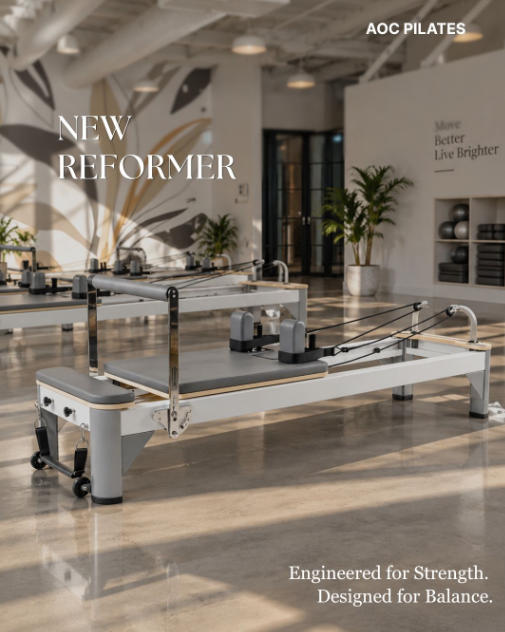
Aluminum Pilates Reformers sit between these two familiar categories. They offer a lighter frame than many wooden models, a cleaner modern appearance, and better resistance to humidity and frequent cleaning. Within the aluminum category, non-folding aluminum Reformers are built for buyers who care less about folding storage and more about long-term frame stability, smooth carriage movement, and consistent training feedback.
So who is a non-folding aluminum Pilates Reformer really for?
The answer is not "everyone who wants professional equipment." It is a more specific choice for studios, instructors, and serious home users who need durability, mobility, and reliable performance over time.

1. Pilates Reformer Market Overview: Wood, Folding, and Aluminum Models
To understand where a non-folding aluminum Pilates Reformer fits, it helps to look at the broader Pilates equipment market first.
Wooden Pilates Reformers are still widely used in professional Pilates studios. They suit traditional studio environments, offer a strong and stable training feel, and often match the premium aesthetic many studios want to create. For many commercial Pilates spaces, especially those focused on classical or full-service instruction, wooden Reformers remain a mainstream configuration.
Folding Pilates Reformers are more commonly used in home fitness settings. Their biggest advantage is storage. Users can fold the machine after training and move it into a corner, closet, or under-bed space depending on the model. For apartments, multipurpose rooms, or occasional home practice, this convenience is often more important than maximum structural rigidity.
Aluminum Pilates Reformers serve a different role. They are usually lighter and more modern-looking than wooden Reformers, while offering stronger structural stability than many folding home-use models—highlighting a key difference in the wood vs. aluminum Pilates Reformer debate. Aluminum frames are also easier to maintain in humid, coastal, or high-use environments.
Within this aluminum category, non-folding aluminum Reformers form a more performance-focused segment. They do not fold flat, but they avoid central hinges and folding joints. This gives them an advantage in frame stability, carriage alignment, and long-term training consistency, especially when the equipment is used frequently across multiple sessions each day.
2. Why Choose a Non-Folding Aluminum Pilates Reformer?
The main value of a non-folding Pilates Reformer comes from its balance of stability, mobility, and lower maintenance demands.
Compared with many wooden Reformers, aluminum models are often significantly easier to move and reposition.
The weight difference can be substantial: a full-size wooden Reformer such as the Full Track Maple Reformer AOC-PL010FW weighs around 105 kg, while a comparable aluminum model like the Elite Aluminum Reformer AOC-PL019 comes in at approximately 70 kg — with nearly identical footprints at around 2450 × 850 mm.
That 35 kg difference is meaningful when a studio needs to adjust the room layout between group Reformer classes, private sessions, mat Pilates, or other training formats. Many commercial aluminum Reformers also include transport wheels, making it easier for one person to reposition the equipment when needed.

Aluminum also performs well in environments where moisture and frequent cleaning are concerns. In coastal areas, warm climates, hot Pilates studios, or hotel wellness spaces, a finished aluminum frame is generally easier to wipe down and maintain than a wooden frame.
Compared with folding Reformers, the biggest advantage is structural continuity. A non-folding frame does not rely on hinges or locking mechanisms at the center of the machine. This helps the rails and carriage maintain a more stable relationship during repeated use.
For light home training, this difference may not be very noticeable. But in a studio or instructor-led setting where the Reformer is used several times a day, small changes in carriage tracking, frame stability, or wheel movement can affect the training experience.
Carriage movement is central to Reformer Pilates. Whether the client is doing footwork, leg circles, short spine, long stretch, or more advanced repertoire, the carriage should move smoothly and predictably. A stable aluminum frame and quality wheel system help support that consistency across every spring setting and exercise variation.
Another practical feature is auminum Reformers can vertical storage. Non-folding aluminum Reformers cannot fold flat, but many models can be stored upright against a wall. This does not replace the convenience of a folding Reformer, but it can help studios or instructors free up floor space between sessions.
Some aluminum Reformers also offer lower frame options, which may be useful for rehabilitation work, older adult training, or clients who need easier access when getting on and off the carriage.

3. Who are the Best users for a Non-Folding Aluminum Pilates Reformer?
A non-folding aluminum Reformer is not a universal choice. It works best for buyers who need a balance of stability, durability, mobility, and professional-level training performance.
3.1 Commercial Pilates Studios With Space or Climate Challenges
Many professional Pilates studios will continue to choose wooden Reformers, especially when they want a traditional studio appearance and do not need to move equipment often.
However, aluminum reformer becomes attractive when the studio has specific operational needs. For example, a studio may need to reconfigure the room several times a day to accommodate group Reformer classes, duet sessions, and mat-based programming. A boutique fitness space may want a cleaner, more modern visual style. A hotel gym or wellness center may prefer equipment that is easier for staff to clean and maintain. A studio in a humid region may also want to reduce the maintenance demands associated with wood-framed equipment.
It is also worth noting that folding Reformers do occasionally appear in commercial settings — we have worked with a studio client in Lithuania, for instance, who equipped their space with four oak folding Reformers. That choice is valid in the right context, but it remains the exception rather than the norm.
For multi-location operators, the equipment decision goes beyond individual machine performance. Experienced chain operators tend to ask not just whether a Reformer is good enough, but whether it can support their full curriculum and be replicated consistently across every location.
One of our clients, an expanding Pilates chain in India, configured each of their studios with aluminum Reformers paired with both a Half Tower and a Full Tower — using the Reformer for foundational core training, the Half Tower for vertical spring work, and the Full Tower for rehabilitation, stretching, and advanced control sequences.
The aluminum Reformer's seamless compatibility with Tower systems made it the natural anchor for that kind of structured, scalable setup. When the same frame type, carriage feel, and spring system are used across locations, it becomes easier to standardize class formats, instructor training, and maintenance procedures.
That said, commercial buyers should not evaluate the frame alone. After-sales support, spare parts availability, warranty terms, and compatibility with jump boards, boxes, and other accessories are just as important. In a studio environment, equipment downtime can directly affect class schedules and revenue.
3.2 Professional Pilates Instructors With a Fixed Teaching Space
For Pilates instructors, consistency is not just a comfort issue. It affects teaching quality.
A professional instructor relies on the Reformer to give clients clear movement feedback. The carriage should glide smoothly, the springs should respond predictably at each resistance level, and the frame should feel stable throughout the exercise. When equipment changes subtly over time, cueing and correction can become less precise.
A non-folding aluminum Reformer is useful for instructors who teach regularly in a fixed space but still need some flexibility in how that space is used. The machine can remain fully assembled during training, then be stored vertically when the room is needed for mat work, assessments, or small apparatus sessions.
This makes it a strong option for private instructors, small studios, rehabilitation practitioners, or wellness professionals who want commercial-level performance without the heavier feel and traditional look of a wooden frame.
3.3 Serious Home Pilates Users With Dedicated Training Space
A non-folding aluminum Reformer can also make sense for home users, but only for a specific type of buyer.
It is not the best choice for someone who needs to fold the machine away after every workout. It is better suited to users who already practice Pilates regularly, understand the feel of studio-quality equipment, and have a dedicated area for training.
For this type of user, the goal is not simply to "own a Reformer." The goal is to recreate a stable, quiet, studio-like training experience at home — with consistent spring tension, smooth carriage travel, and the kind of movement feedback that supports real progress over time.
Noise can also matter more in residential settings. A well-built aluminum Reformer with quality wheels and rails can operate quietly, which is useful for early morning or evening practice. The machine can stand vertically when not in use, but it still requires a permanent or semi-permanent training area.
For committed users, the higher upfront cost may be easier to justify over years of regular practice. The value comes from durability, consistency, and a better training experience over time.

4. Folding vs Non-Folding Aluminum Pilates Reformer: Key Differences
The difference between folding and non-folding aluminum Reformers is not simply about quality. It is about priorities.
Feature | Non-Folding Aluminum Reformer | Folding Aluminum Reformer |
Best suited for | Studios, instructors, serious home users with dedicated space | Home users and space-limited environments |
Main advantage | Stable frame and consistent carriage movement | Easy storage |
Structure | Fixed-frame design with no central folding joint | Folding design with hinges and locking mechanisms |
Storage | Can often be stored vertically | Can fold flat or compactly |
Mobility | Usually movable with transport wheels, but not highly portable | Easier to move and store after folding |
Maintenance | Fewer moving structural parts | Folding joints or hydraulic systems may need more attention |
Long-term use | Better suited to frequent or commercial use | Better suited to light or moderate use |
Accessory compatibility | Often stronger, especially with Tower systems | Depends heavily on the model |
Buyer priority | Training consistency and durability | Space saving and convenience |
The simplest way to think about it is this:
A folding Reformer solves a storage problem.
A non-folding aluminum Reformer solves a consistency and durability problem.
They are built for different users.
5. Who Should Not Buy a Non-Folding Aluminum Pilates Reformer?
A non-folding aluminum Reformer is not always the best answer.
If your training space is also your living room, bedroom, or office, and the Reformer needs to disappear completely after each session, a folding model is probably more practical.
If you only practice occasionally, the advantages of a non-folding frame may not matter enough to justify the higher price. A good folding Reformer can be suitable for light or moderate home use.
If your studio values a traditional Pilates aesthetic above all else, a wooden Reformer may still be the better fit. Wood has a visual warmth and heritage that aluminum does not try to imitate.
If budget is the main deciding factor, non-folding aluminum models may feel expensive compared with entry-level folding Reformers. Their value becomes clearer when they are used frequently and over a longer period of time.
6. Non-Folding Aluminum Pilates Reformer Brands and Buying Reference
The mainstream non-folding aluminum Reformer category is largely led by professional brands from Europe and North America, which have been tested across studio, rehabilitation, and professional training environments. Based on market positioning and price, they fall into three broad tiers.
Premium brands (e.g. Balanced Body Allegro 2, Align-Pilates C8-Pro) are widely used as performance benchmarks, known for refined carriage feel, mature accessory ecosystems, and strong service networks.
Mid-to-upper professional brands (e.g. Elina Pilates Aluminum HL2, RESISTA Aluminum Reformer) offer reliable studio performance at a more accessible price point.
Value-professional brands (e.g. Raetin Elite White, MICON MC-PL1003) target budget-conscious commercial studios or advanced home users who want serious equipment without entering the highest price tier.
That said, brand alone should not drive the decision. Even within the same brand, models can differ significantly in spring configuration, frame height, accessory compatibility, and upholstery quality. Testing the Reformer in person — evaluating carriage movement, spring response, wheel noise, and overall frame feedback — remains the most reliable way to make the right choice.

7. Non-Folding Aluminum Pilates Reformer Buying Advice: Is It Right for You?
A non-folding aluminum Pilates Reformer is not a universal upgrade. It is a specific solution for buyers who need more stability than a folding model can usually provide, but who may not want the weight, maintenance requirements, or traditional appearance of a wooden Reformer.
It is especially suitable for:
Commercial Pilates studios with space, humidity, or layout challenges
Professional instructors who need reliable equipment in a fixed teaching space
Serious home users with a dedicated training area
For buyers whose main concern is storage, a folding Reformer is still the more practical choice. For studios that want a classic Pilates environment, wooden Reformers remain a strong option.
But when the priority is consistent carriage movement, easier maintenance, modern appearance, and reliable long-term use, a non-folding aluminum Pilates Reformer has a clear place in the market.
The right question is not:
Is aluminum better than wood or folding?
The better question is:
What problem do I need this Reformer to solve?
Once that answer is clear, the right category becomes much easier to choose.


Trending Now
-

Wood vs Aluminum: Which Pilates Reformer Is Right for Your Studio
2026-09-10 10:20:07 -

Non-Folding Aluminum Pilates Reformer: Who Is It Really For?
2026-09-10 10:10:59 -
Why Do Indian Pilates Studio Chains Prefer Purchasing Aluminum Reformers?
2026-09-10 10:05:15 -

Custom Aluminum Folding Pilates Reformer with a Removable Carriage
2026-09-10 10:00:55 -

The Value of Removable Legs in Modern Aluminum Pilates Reformers
2026-09-10 09:58:46 -

Why Aluminum Pilates Reformers Are More Popular in Commercial Pilates Studios
2026-09-10 09:56:09 -

Why Anodized Aluminum Rails Are Ideal for Maple Pilates Reformers
2026-09-10 09:50:20 -

How to Choose Pilates Reformer Tracks: Aluminum vs Stainless Steel
2026-09-04 14:14:55 -

What Really Matters When Evaluating a Pilates Equipment Manufacturer
2026-06-25 15:17:50 -

Aluminum Pilates Reformer Frame Specs: 6063‑T5, 2.0–2.5 mm Profiles, Electrostatic Powder Coating
2026-05-27 11:30:20