
How Brazilian Pilates Equipment Is Built: Frame Construction, Assembly and Local Engineering Choices
Brazilian Pilates equipment is easy to recognize, but not always for the reasons people expect.
Wood remains widely used, while carbon steel is common in both classical and contemporary equipment. Many locally manufactured machines combine wooden or steel frames with stainless-steel hardware, aluminum rails and imported bearings. Fully aluminum Pilates reformers, by contrast, are more often imported. This has contributed to a distinct Brazilian manufacturing tradition, with local producers developing their own approaches to frame construction, assembly and transportation.
These choices are not simply attempts to reproduce European or North American Reformers at a lower cost. They reflect Brazil's own material supply, domestic freight conditions, studio market and manufacturing capabilities.
Looking closely at how a Brazilian Pilates Reformer is actually built reveals more than comparing wood species or frame colors. The more interesting differences appear in the chassis, joints, detachable structures, carriage system and the way the equipment reaches the studio.
1. Brazilian Pilates Equipment Is Built Around Materials That Are Easy to Source Locally
The most obvious local characteristic is the continued importance of wood.
Brazilian manufacturers frequently use eucalyptus or other plantation-grown hardwoods for Reformers, Cadillacs, Chairs and Barrels. This makes industrial sense. Brazil has a mature forestry and woodworking industry, so large wooden structures can be produced domestically without importing bulky frames.
Arktus, for example, specifies natural eucalyptus combined with carbon steel and stainless steel in its Clinical Reformer. Brazilian Pilates Equipment manufacturers commonly use carbon steel where structural strength is required and stainless steel around exposed, sliding or high-contact areas.
This produces a construction style that is often more mixed than the simple label "wooden Reformer" suggests.
The main chassis may be wood, while the carriage support, pulleys, bars, fasteners and reinforcement structures use different metals according to function. Physio Pilates goes further by combining a substantial wooden chassis with tubular aluminum rails and an aluminum carriage base.
The same logic can be seen in upholstery. Brazilian Factory commonly specify materials such as EVA and nautical-grade synthetic coverings designed to tolerate repeated cleaning, humidity and commercial studio use. Kauffer, for example, uses EVA padding with nautical synthetic upholstery on its Reformer Tower.
The result is equipment designed around a local supply chain rather than around a single "premium" material.
2. Brazilian Reformer Frames Are Not Simply Bolted-Together Furniture
One of the most useful comparisons with traditional North American and European equipment is the way the main chassis is constructed.
Premium American wooden Reformers generally treat the four-sided chassis as a permanent structural assembly. Balanced Body provides a particularly clear example. Its Studio Reformer frame is assembled in the factory using half-inch wooden dowels and adhesive, with the four sides joined before the legs are individually fitted and glued into the bottom of the frame. The customer receives the Reformer largely structurally complete and only installs components such as springs, shoulder rests and risers.
In other words, the geometry of the main load-bearing structure is established at the factory.
Gratz follows the same philosophy in a different material. Its classic aluminum Reformer uses a welded, fully integrated unibody frame. The emphasis is again on maintaining the primary chassis as one controlled structure rather than asking the customer to create the fundamental geometry during final assembly.
Brazilian manufacturers often pursue the same goal—rigidity—but use different construction methods.
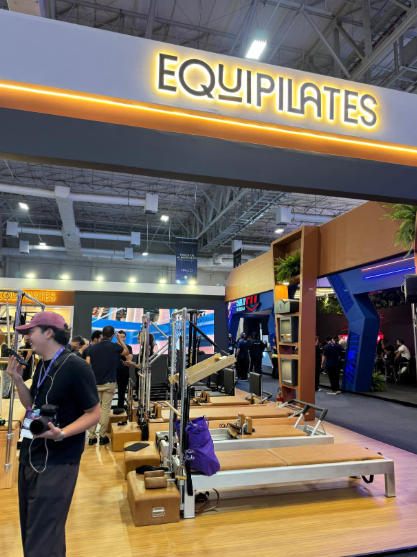
Equipilates states that its wooden Reformer chassis uses substantial timber sections together with mortise-and-tenon-style joints and adhesive bonding. This is significant because the joint itself is designed to become part of the structural chassis rather than relying only on removable screws.
Physio Pilates is even more explicit. It uses high-strength bonded wooden joints and argues that this avoids the permanent gaps and creaking that can develop when highly loaded wooden components depend primarily on screwed connections. Its approach is conceptually closer to traditional premium wooden Reformer construction than to flat-pack furniture.
So the real distinction is not "Brazil uses joints while the US and Europe do not."
Both do.
The difference lies in how individual Brazilian brands balance permanent chassis construction with removable secondary structures.
3. Brazilian Manufacturers Tend to Be More Flexible About What Is Assembled at the Studio
This is where local practice becomes more distinctive.
Brazil is a very large country. Equipment may travel thousands of kilometers by truck before reaching a studio, and domestic freight cost matters. Manufacturers therefore have an incentive to reduce package size where they can do so without compromising the critical geometry of the machine.
Arktus is one of the clearest examples. Its Clinical Reformer is explicitly delivered disassembled with a mounting kit and assembly manual. Its Tower products also use bolt, nut and washer connections and are delivered for on-site assembly.
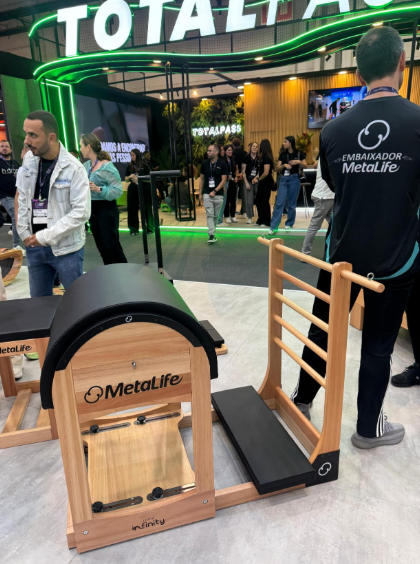
MetaLife uses a somewhat different approach. On the Infinity Reformer, the main base structure remains a large factory-produced assembly, while the feet are installed onto that base during final setup using locating dowels and fasteners. The carriage and other components are then installed around the completed structure.
Kauffer also highlights a fitted connection between the feet and the main structure as a way of improving equipment stability.
This is an important local design pattern. The factory tries to preserve the geometry that affects movement and stability, while parts that mainly affect height, transport volume or accessories can remain detachable.
Traditional Western equipment also uses partial assembly, but the degree varies by product.
Balanced Body's Studio Reformer arrives with its main wooden structure already built; the customer mainly installs springs, shoulder rests and risers. Its aluminum Allegro 2 goes further and allows legs and the Footbar to be attached during setup.
British brand Align-Pilates also ships its A8-Pro with the main aluminum frame separate from the carriage, standing platform and legs, and the customer bolts the legs and several other components into the prepared chassis.
The difference is therefore not a clean geographic divide. What stands out in Brazil is how often domestic logistics becomes part of the engineering decision, especially on heavy wood and steel equipment.
4. The Important Question Is Where the Reformer Is Allowed to Come Apart
This distinction matters for any Pilates equipment factory designing for Brazil.
A machine can be technically "knock-down" without compromising its performance. The problem appears when the connections that determine rail alignment, frame squareness or carriage geometry are also left to field assembly.
Premium equipment generally tries to avoid that.
The most successful designs separate the machine into two categories: structural geometry that should be fixed and tested in the factory, and transport-oriented components that can safely be installed later.
A leg is very different from a rail.
A Tower upright is different from the relationship between two carriage tracks.
A shoulder rest can be installed by a technician without changing the squareness of the chassis. A poorly aligned structural rail connection can change how the entire Reformer feels.
This helps explain why Brazilian manufacturers use several apparently contradictory strategies at the same time. Equipilates and Physio invest in bonded wood chassis construction, while Arktus and MetaLife make selected components removable. These are not necessarily opposing ideas.
The permanent structure provides rigidity. The removable parts make the machine practical to transport through Brazil.
For an export manufacturer, the lesson is important. Designing for the smallest possible carton is not automatically good engineering. If transportation savings create more assembly labor, alignment risk and after-sales calls, the total cost may actually rise.
5. Brazilian Reformers Often Combine Local Structure With Different Rail and Carriage Solutions
The carriage system is another area where there is no single "Brazilian standard."
Some local manufacturers build most of the machine domestically but source selected motion components internationally.
Equipilates, for example, specifies an eight-wheel carriage system using imported bearings. The structural chassis is produced locally, but the company is willing to use an imported component where precision or supplier specialization provides an advantage.
Physio Pilates takes another route, combining a wooden chassis with tubular aluminum rails and an aluminum carriage base.
This approach is not far removed from established international equipment architecture.
Balanced Body's Studio Reformer uses a precision carriage system with four load-bearing vertical wheels and four adjustable guide wheels, while Align-Pilates' A8-Pro uses precision aluminum runners and eight polyurethane wheels.
What differs is how each manufacturer integrates that motion system into the rest of the machine.
Brazilian equipment often starts with a locally economical wooden or steel chassis and then builds the rail and carriage solution around it. International aluminum platforms are more likely to make the runner profile itself a central part of the structural architecture.
That distinction is more useful than simply saying one market has "better rails."
6. Brazilian Equipment Also Reflects a Different Attitude Toward Maintenance and Replaceable Parts
Another characteristic of the Brazilian market is that equipment is often expected to remain in service for a long time.
That affects component choices.
Springs are a good example, but they should be understood as one small part of this broader maintenance philosophy rather than the defining feature of Brazilian equipment.
Some international premium and export-oriented Reformers use German or Korean spring options. Brazilian manufacturers, however, have developed several local alternatives. Equipilates and Arktus use nickel-plated carbon-steel springs, while Kauffer uses black E-Coat springs with an electrodeposition finish designed to improve corrosion protection.
During the Brazilian field research behind this article, local users also reported black-coated springs remaining in service for many years without major failure. That is useful evidence of real-world durability, although it should not be confused with a recommended replacement interval.
More important than the color of the spring is the broader pattern: Brazilian factories are comfortable developing local solutions for parts that can be supported and replaced domestically.
The same principle applies to upholstery, ropes, fasteners and structural hardware.
For a Brazilian studio, the ability to obtain a replacement part locally may be more valuable over ten years than whether the original component was imported from Germany, Korea or China.
7. What Is Actually Different About Brazilian Pilates Equipment?
The clearest difference is not one individual material or component.
It is the way the product is optimized around the Brazilian manufacturing and distribution environment.
Traditional premium North American and European equipment tends to put strong emphasis on factory-controlled chassis geometry. Balanced Body's glued and doweled wood frame, Gratz's welded aluminum unibody and the pre-engineered aluminum frames used by companies such as Align-Pilates all reflect that philosophy.
Brazilian manufacturers share the same concern for structural stability, but they frequently combine it with greater transport modularity.
The main wooden chassis may be bonded permanently, while the feet, Tower or external components remain removable. A machine may use local eucalyptus and carbon steel but imported bearings. Another may use domestic wood with aluminum rails. A third may arrive largely disassembled because the manufacturer has built its installation and service model around that approach.
That makes Brazilian Pilates equipment neither a simplified version of European and American equipment nor a completely different engineering category.
It is equipment that has evolved around different industrial constraints.
Brazil has inexpensive access to the bulky materials. Domestic manufacturers have metalworking and woodworking capability. Long-distance internal transport rewards modularity. Local service networks make field assembly realistic. At the same time, manufacturers protect the parts of the Reformer where rigidity and alignment matter most.
For an international Pilates equipment factory studying this market, that is the real insight.
The opportunity is not to copy the Brazilian appearance.
It is to understand why Brazilian manufacturers chose those structures in the first place, and then decide where a different engineering solution can genuinely improve stability, assembly time, transport efficiency or long-term service.


Trending Now
-

Wood vs Aluminum: Which Pilates Reformer Is Right for Your Studio
2026-09-10 10:20:07 -

How to Choose Pilates Reformer Tracks: Aluminum vs Stainless Steel
2026-09-04 14:14:55 -

Wunda Chair Springs and Pedals: How Resistance Really Works
2026-08-31 10:03:00 -

Why a Pilates Studio Customer Customized an L-Shaped Reformer Track
2026-08-04 09:00:47