
Pilates Reformer Pulley Height: How to Adjust It and Why It Matters
Pulley height is a small part of a Pilates reformer, but it has a clear job. The pulley sets the point where the rope changes direction behind the carriage, and changing its height changes the rope path and pulling angle.
Most adjustable reformers use a rope riser or pulley post to control this position. The height is usually defined by a series of preset holes rather than an unlimited range of movement.
What has changed over time is the way those positions are adjusted.
On many traditional reformers, changing pulley height means releasing and moving the whole rope riser. Newer designs can keep the main riser in place and move only the pulley holder. The available positions may be similar, but the adjustment becomes noticeably quicker.
For Pilates studios comparing reformers, this is one of those small mechanical differences that is difficult to appreciate from a product photo but easy to notice once the equipment is being adjusted regularly.
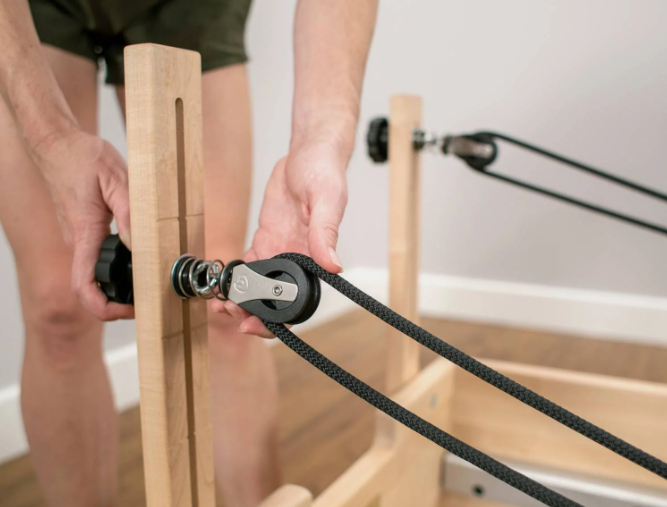
1. What Does Pulley Height Change on a Pilates Reformer?
The pulley guides the rope as it travels between the straps and the carriage. Its vertical position affects where the rope changes direction.
Moving the pulley higher or lower therefore changes the rope angle.
The exact setup varies between reformers because frame height, carriage geometry, rope length and pulley position are designed as one system. There is no single pulley height that applies to every reformer.
This is why many commercial pilates machines provide several pulley positions.
A typical adjustable rope riser may have a series of holes running vertically along the post. Each hole represents a defined pulley height. Both sides can be set to the same position without measuring them individually.
Preset positions are simple, repeatable and easy to check.
The bigger difference between reformers is often how the pulley gets from one of those positions to another.
2. How Traditional Rope Risers Adjust Pulley Height
A common traditional Pilates reformer rope riser is a movable post.
The pulley is attached to the riser, while the riser itself slides vertically through its mounting point at the rear of the reformer. A pin, knob or similar fastener holds it at one of several preset heights.
To change the pulley position, the locking mechanism is released, the whole riser is raised or lowered, the next hole is aligned, and the riser is locked again.
It is a simple structure with relatively few components. The adjustment positions are clearly defined, and the same setting can easily be repeated on both sides.
There are other traditional constructions as well. Some wood-frame reformers use a fixed wooden upright with separate metal adjustment hardware for the pulley rather than moving the entire wooden post. Wood also naturally behaves differently under load: in one 142 kg single-side load test, a wooden riser showed some temporary flex but returned to its original position after unloading, without visible cracking or breakage.
These variations show that a rope riser does not have to follow one particular construction. Its essential function remains the same: support the pulley and provide reliable height positions.

3. Why Newer Pulley Height Adjustment Can Be Faster
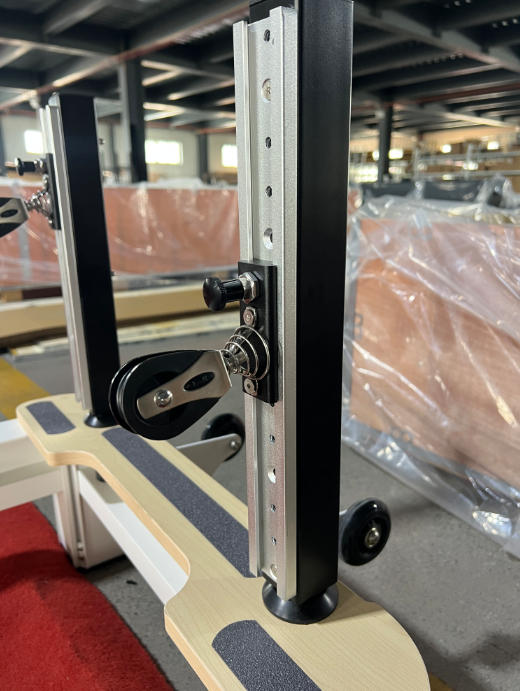
The newer aluminum design keeps the preset-hole principle but changes the moving part.
Instead of lifting or lowering the complete rope riser, the aluminum section remains in place while the pulley holder moves along it.
The adjustment sequence is shorter: release the locking control, move the pulley holder to the required position, and lock it into the corresponding hole.
The difference is mechanical rather than conceptual.
Both systems still use predefined height settings. The newer version does not turn the pulley into an infinitely adjustable component, nor does it automatically give the reformer more usable positions.
It simply makes those positions quicker to change.
This is an important distinction because “more adjustable” and “easier to adjust” are not the same thing.
A traditional riser may provide exactly the same number of height options. The aluminum design improves the way the user moves between them.
4. Why Keeping Preset Pulley Positions Still Makes Sense
It would be possible to design a pulley holder that locks anywhere along a rail, but preset holes have practical advantages on Pilates equipment.
The first is consistency.
When both sides use the same numbered or defined position, pulley height can be matched without measuring from the frame.
The second is positive location.
The locking system has a physical reference point rather than relying entirely on friction to hold an approximate height.
That is particularly useful on equipment that is adjusted repeatedly. The user can move directly to another known setting and confirm that the mechanism has engaged correctly.
The newer aluminum rope riser therefore combines two ideas that already work well: preset height positions and quicker pulley movement.
The change is in the handling, not in abandoning the traditional positioning principle.
5. What Faster Pulley Adjustment Means in a Pilates Studio
Pulley height is not changed constantly during every Pilates session, so the benefit should not be exaggerated.
It matters when a change is required.
A traditional moving riser means handling the complete post. Depending on its size and locking arrangement, that may involve supporting the riser while releasing and locating the next position.
When only the pulley holder moves, the adjustment is concentrated into a smaller part of the mechanism. The main upright stays where it is.
That makes the action more direct.
For a home reformer that stays in one setup most of the time, the difference may be relatively minor. On commercial equipment, where settings are changed more regularly and several instructors may use the same machines, convenient adjustment becomes more noticeable.
Studios already see the same idea elsewhere on a reformer. Footbars, springbars and rope-length systems are often judged partly by how quickly and clearly they can be repositioned.
Pulley height belongs in the same category.
The underlying function may be simple, but a better adjustment mechanism can reduce unnecessary handling around the machine.
6. Why an Aluminum Adjustable Rope Riser Costs More
The faster adjustment comes from a more involved structure.
A traditional metal rope riser can use the post itself as both the supporting member and the moving part. Add a series of holes and a locking pin, and the basic height-adjustment mechanism is complete.
The aluminum version separates those functions.
The main aluminum section acts as the guide and support, while a separate pulley holder moves along it. The assembly also needs its own locking and locating hardware.
That means more components and more fitting work.
The pulley holder needs enough clearance to move easily, but excessive clearance can make the assembly feel loose. The locking mechanism has to engage reliably at each height while remaining easy to operate.
Machining and assembly are therefore more demanding than on a simpler moving-post design.
This is where much of the extra cost comes from.
It is not simply a case of replacing steel or wood with aluminum. The pulley adjustment mechanism itself is more complex.
7. Faster Adjustment Is the Main Difference
Traditional rope risers already do the essential job well. They support the pulley, provide several height positions and use a simple mechanical locking system.
The newer aluminum design keeps those basic principles.
The pulley still moves between preset positions. Both sides still need to be set at the same height. The selected position still needs to remain firmly locked during use.
The main difference is that the complete riser no longer has to be repositioned to change pulley height. The pulley holder moves instead.
That makes the adjustment quicker and more direct while retaining the certainty of preset holes.
For a Pilates studio comparing reformers, this is a more meaningful distinction than simply describing one design as traditional and the other as premium.
A rope riser can be simple and reliable. An aluminum adjustment system can cost more and still be worth considering for a very specific reason: it reduces the effort involved in changing pulley height.


Trending Now
-

The Value of Removable Legs in Modern Aluminum Pilates Reformers
2026-09-10 09:58:46 -

Why Maple & Oak Are the Go-To Woods for Wooden Pilates Reformers
2026-09-10 09:53:30 -

Why Anodized Aluminum Rails Are Ideal for Maple Pilates Reformers
2026-09-10 09:50:20 -

How to Choose Pilates Reformer Tracks: Aluminum vs Stainless Steel
2026-09-04 14:14:55