
How Can One Pilates Reformer Create More Revenue?
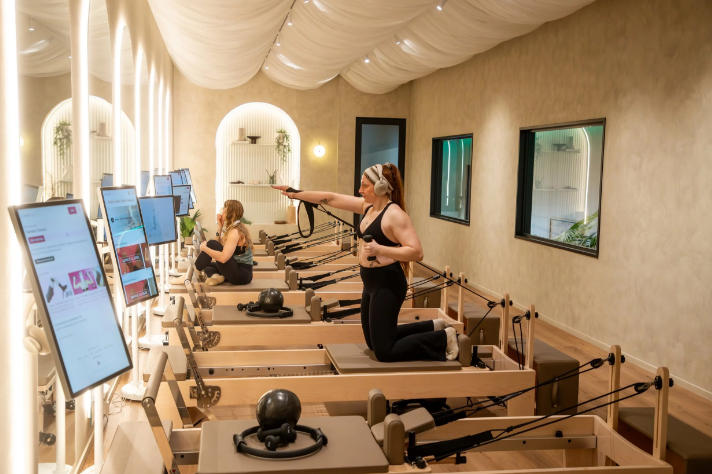
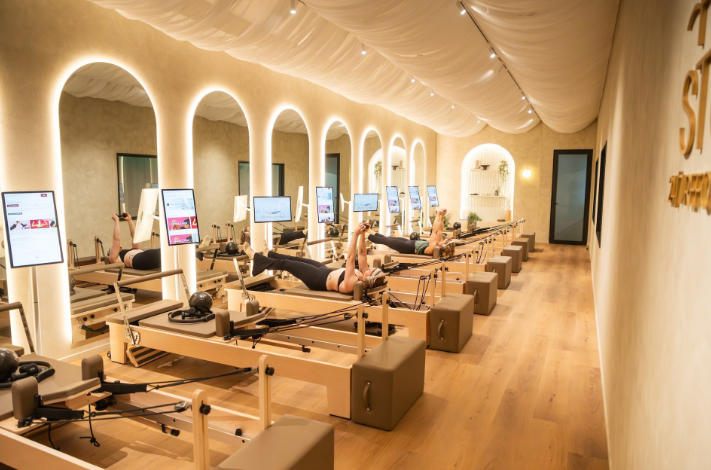
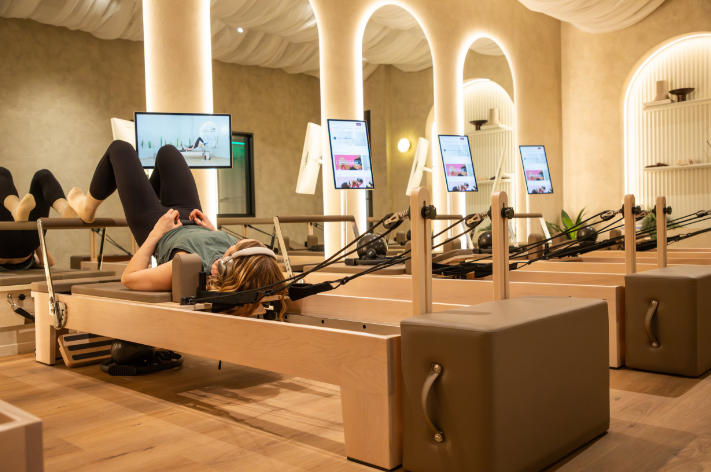
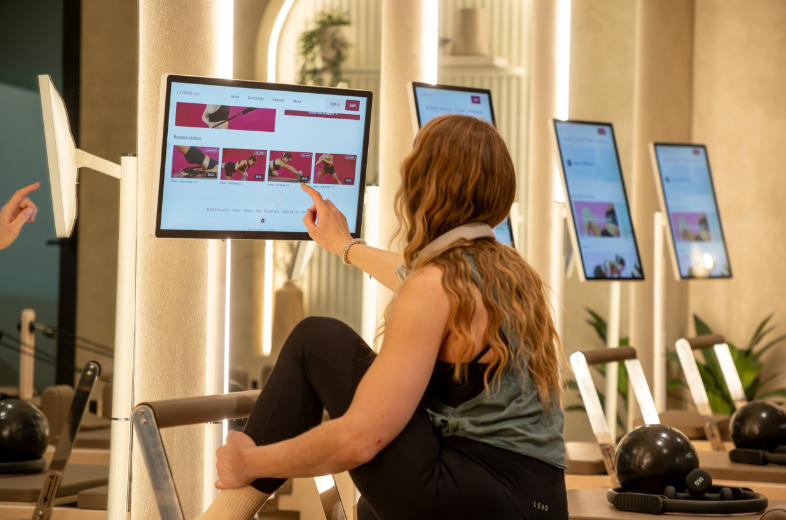
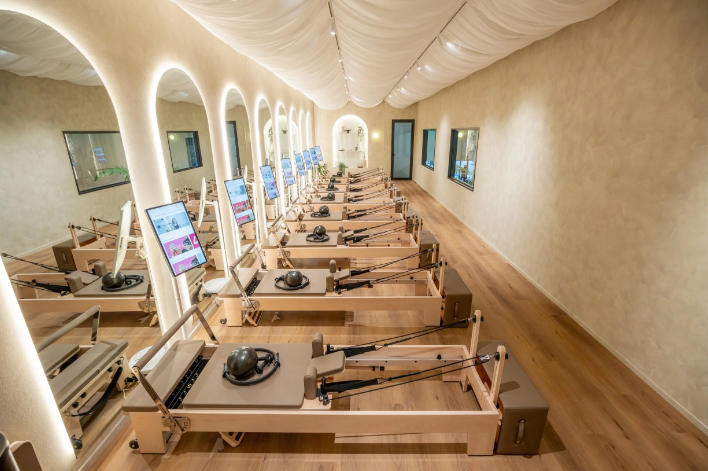
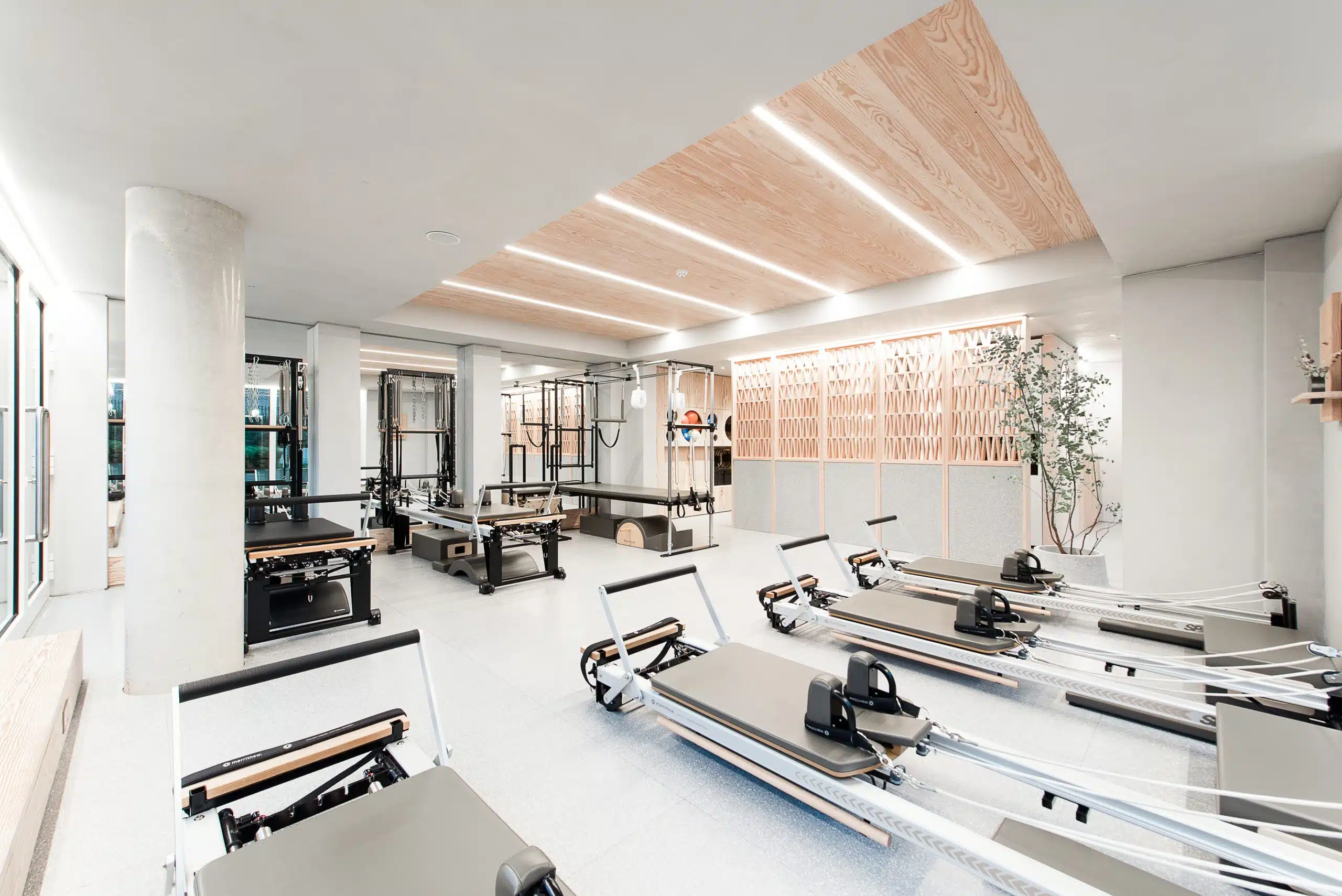
Look at the Australian client studio shown here. Each Reformer is paired with an individual display and headphones, while a coach is still present in the room. The space combines several ways of delivering a workout: instructor-led classes, guided digital content and more flexible individual training.
For a studio operator, the important point is not simply the presence of smart screens. It is the way the same group of Reformers can support different services throughout the day.
A Reformer Pilates studio does not necessarily increase revenue by adding more classes or extending its opening hours. A more effective approach is to match each time period with the right customer and service: live group classes when demand is strongest, shorter sessions during the working day, private or introductory training in quieter periods, and digital content when self-guided exercise is appropriate.
1. How Reformer Pilates Studios Turn Equipment into Revenue
A Reformer is not only a piece of fitness equipment. It is a capacity asset that can generate revenue through several different services.
The same machine may be used for a group class in the morning, a private session in the afternoon and a guided individual workout later in the day. These services have different prices, staffing requirements and customer expectations.
A full group class is not automatically the most profitable use of the equipment. A small private session may generate more revenue per Reformer-hour, while a digital session may reduce the amount of instructor time required. The relevant measure is the relationship between actual revenue, equipment time and delivery cost, which together shape commercial Reformer ROI.
This means that a studio should evaluate:
actual attendance rather than bookings alone;
revenue per Reformer-hour rather than headline class price;
instructor cost for each session;
cancellation and no-show losses;
member retention and repeat attendance.
The commercial objective is not to fill every hour with the same type of class. It is to make each available hour commercially useful.
2. Why Reformer Pilates Peak Hours Vary by Market
Before removing a lunchtime or afternoon slot, test a format that suits the clients available then. Office-led studios may find demand for Express Reformer classes, while residential or mixed-use locations may be better suited to beginner, private or duet sessions. Use your own attendance, cancellation and revenue data to decide whether the slot earns a place in the timetable.
ClassPass reported that the most popular global workout time in 2025 was 6:00 p.m. on weekdays and 10:00 a.m. on weekends. At the same time, reservations between 11:00 a.m. and 1:00 p.m. increased by 38%. Pilates remained the platform’s most-booked workout for the third consecutive year, while Reformer Pilates bookings increased by 71% year over year.
However, ClassPass data represents platform reservations, not the occupancy and profitability of every Reformer studio. Early-morning and post-work sessions also experience relatively high levels of late cancellation and no-show activity. A popular booking time is therefore not always the same as a profitable operating time.
The experience of individual operators can be different. Ten Health & Fitness, which operates ten London studios, identifies mornings, lunchtimes, evenings and weekends as busy periods. Its model combines Reformer Pilates with physiotherapy, massage, clinical exercise and personal training.
Use these broader patterns as a starting point, then confirm your own timetable through attendance, cancellation and revenue data.
3. What US, UK and European Reformer Studios Do Differently
The international market shows several distinct ways of improving the commercial value of Reformer equipment.
In the United States, the dominant scalable model is standardized group training supported by recurring memberships. Club Pilates reported 1,414 operating studios globally as of December 31, 2025. Its typical studio is approximately 1,500 square feet and is designed for up to around 12 participants. The model combines four-class, eight-class and unlimited monthly memberships with single classes and private training.
Memberships make revenue more predictable, while a standardized class experience supports repeat attendance across locations.
The UK shows a broader multi-service approach. Reformer Collective operates studios across London, Brighton and Hove, offering Reformer, Tower, Barre, Mat and infrared classes alongside class packs and memberships.
The same studio can function as a multi-revenue space for Reformer, Mat, recovery, private and workshop bookings.
Continental European examples place more emphasis on small groups and personalized services. RE:FORM in Hamburg limits Reformer classes to nine participants and also offers private, duet, Mat, Yoga and corporate sessions. Reformation Pilates in Paris combines single classes, class packs, monthly memberships and private training across three studios.
These models are not interchangeable, but they share one principle: a studio becomes less dependent on a single group-class product when it develops several ways to sell its equipment, space and instructor time.
4. How to Schedule Reformer Pilates Classes for Higher Utilization
A productive timetable does not simply repeat the same class from morning to evening. It assigns different roles to different parts of the day.
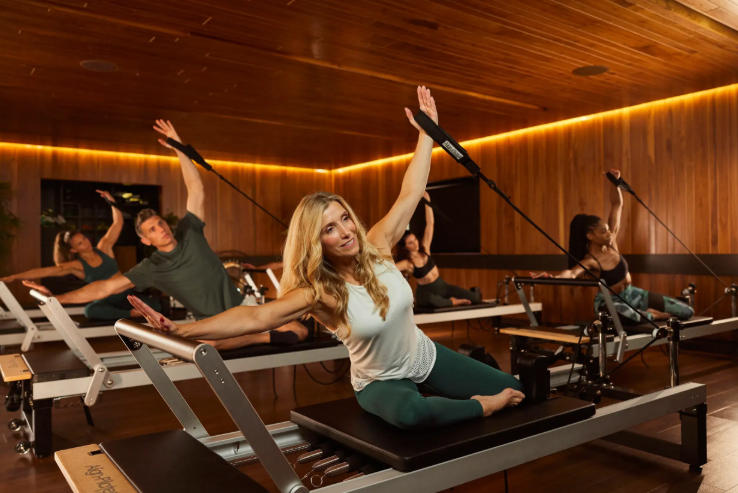
Morning and evening are generally suitable for established group products. These may include standard Reformer classes, popular instructors, advanced sessions and higher-energy formats. Because demand is often concentrated in these periods, studios can use fixed memberships, advance booking and waitlists to protect availability.
Lunchtime requires a more time-efficient offer. Office-based clients may be interested in Pilates but unable to commit to a long session or a complicated arrival process. A 40- to 45-minute Express Reformer class, posture-focused session or corporate package can make the midday period more practical. The objective is not necessarily to discount the class, but to reduce the time required to participate.
Afternoon sessions should usually be designed around different customer groups rather than treated as weaker versions of evening classes. Beginner introductions, prenatal sessions, rehabilitation-focused training, private lessons, duets and flexible sessions for remote workers can all be tested during this period.
Weekends provide an opportunity to sell a different experience. Longer workshops, advanced classes, member events, private bookings and small-group sessions can generate more value than simply adding another standard class.
These time periods are not universal benchmarks. They are product hypotheses that should be adjusted according to the studio’s location, customer base and operating costs.
5. Where Smart Screens and On-Demand Reformer Pilates Fit
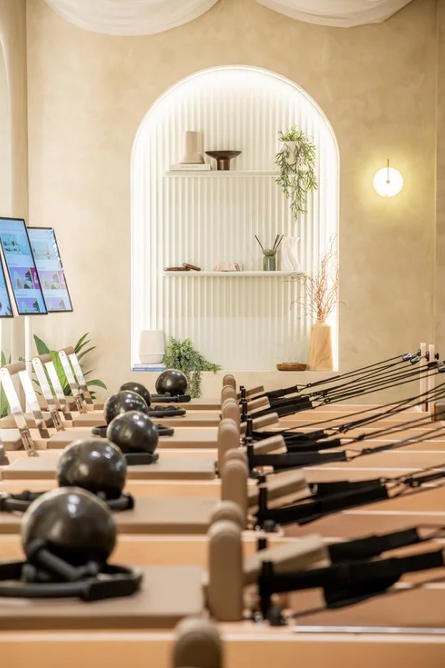
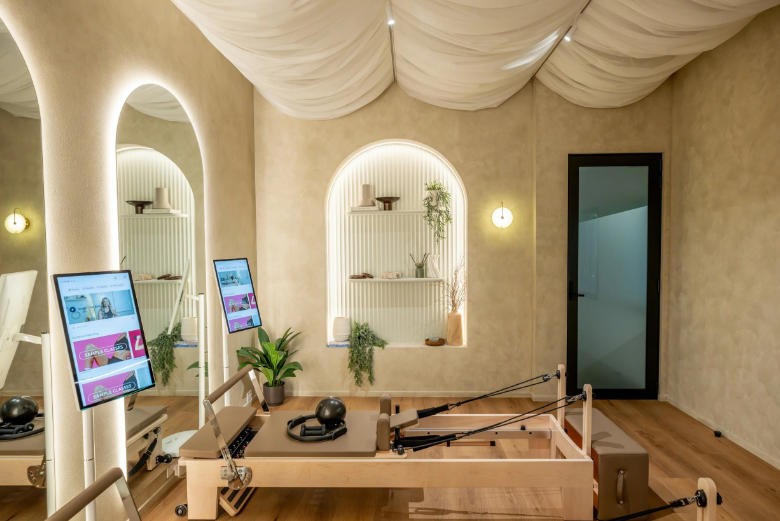
The Australian client images illustrate one possible solution: combining Reformers, individual displays, headphones and instructor presence within the same studio environment.
The images should be presented as a customer case, not as proof that smart-screen Reformers are already standard across Australia, Europe or the United States. They demonstrate a physical setup, but they do not independently confirm the studio’s revenue, occupancy, class structure or level of instructor involvement.
Digital content is also being adopted by commercial gyms. In the United States, 24 Hour Fitness launched Reformer24 as a hybrid model using private controlled-access rooms, video-led training and more than 800 on-demand classes.
In Vienna, Weform provides more than 100 Reformer videos and equips each machine with a screen or tablet, while continuing to offer instructor-led classes for up to six participants. Reformer Infinity uses live classes during selected morning and evening periods and offers on-demand training across broader opening hours.
Mellow Pilates in the Netherlands also combines self-guided sessions, live group classes and private training. Its self-guided service is designed for clients who already understand the basic use of a Reformer.
These examples suggest a practical division of roles. Instructor-led sessions are most valuable for new clients, complex movements, rehabilitation, prenatal training and clients who need direct correction. Digital sessions are more appropriate for experienced members who want repetition, flexible timing or a lower-cost training option.
Digital content can extend the usefulness of a studio, but it cannot create demand where the underlying product is unsuitable. If a quiet afternoon period has no clear customer proposition, adding a screen will not automatically make it profitable.
6. How to Measure Reformer Studio Utilization and Profitability
A studio should review new timetable changes over a meaningful test period, ideally eight to twelve weeks. New classes often receive temporary attention during their first few weeks, so decisions should be based on sustained performance rather than launch-period bookings.
The most useful measures are:
Metric | Operating value |
Reservations | Indicates initial demand |
Check-ins | Shows actual attendance |
Late cancellations and no-shows | Reveals lost capacity |
Waitlist activity | Indicates unmet demand |
Revenue per class | Measures commercial output |
Instructor cost | Shows delivery cost |
Revenue per Reformer-hour | Compares equipment productivity |
Repeat attendance | Indicates whether the product has long-term value |
When a class underperforms, the solution is not always cancellation. The studio may need to change the class length, instructor, format, price, booking channel or target customer. ClassPass’s guidance for studio partners recommends testing these variables before permanently removing a class from the schedule.
There is no universal occupancy target that applies to every Reformer studio. A class with fewer participants may still be worthwhile if it has a lower delivery cost or supports future private-session revenue.
7. What Commercial Reformer Equipment Must Support
As studios move beyond a single group-class format, the equipment must support more frequent changes in use.
When choosing a commercial Pilates Reformer, consider durability, quiet operation, fast adjustment, easy cleaning and compatibility with different body types. They should work equally well for group classes, private training and duet sessions.
For operators, the most valuable equipment is not necessarily the equipment with the most visible technology. It is equipment that reduces setup time, minimizes downtime, supports different services and remains reliable across repeated daily use.
Replacement parts, preventive maintenance and after-sales support directly affect studio profitability.
Smart screens may become part of a studio’s operating model, but they are only one layer of the customer experience. The Reformer itself still determines how efficiently the studio can run classes, transition between clients and maintain consistent service quality.
8. Conclusion: Make One Reformer More Flexible Before Buying More Reformers
The Australian client example shows how digital content can be integrated into a Reformer studio, but it does not provide a universal formula for success.
The broader lesson from the US, UK and European markets is that studios are finding different ways to increase the value of the same equipment. Some rely on standardized memberships and group classes. Others combine small groups, private training, additional wellness services or on-demand content.
The most reliable strategy is to match the product to the customer and the time period. A Reformer may support a full group class in the evening, an Express session at lunchtime, private training in the afternoon or guided independent practice for an experienced member.
The goal is not to keep every machine busy at any cost. It is to make each operating hour commercially useful, while maintaining safety, service quality and a sustainable cost structure.


Trending Now
-
Studio-Grade vs Commercial Pilates Reformers: Durability and Performance Compared
2026-09-28 08:57:32 -

How to Build a Pilates Reformer: What “Commercial Grade” Means
2026-06-08 14:06:29 -

How Surface Finishing Affects Wooden Pilates Reformers in Commercial Studios
2026-06-01 11:26:54 -

Commercial vs Home Pilates Reformer: Why the Price Gap Exists
2026-04-15 10:28:12 -

Commercial Pilates Reformer Investment & ROI Guide
2026-01-20 11:13:57